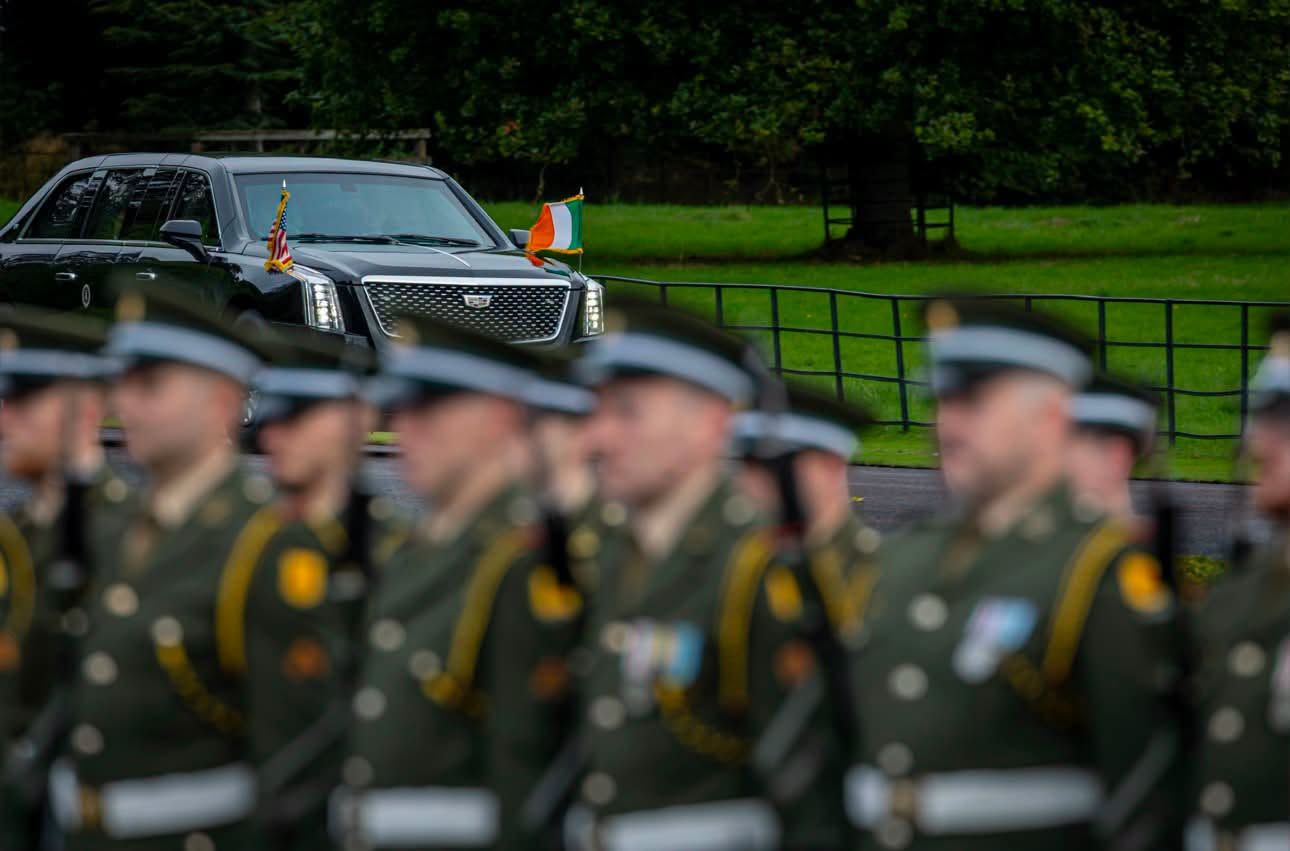
President Donald Trump’s two-day visit to Ireland provided the first truly high-profile test of the Defence Forces’ new Joint Task Force headquarters the “Octagon” at McKee Barracks.
The visit required security operations across Dublin, Shannon and County Clare. Gardaí described it as one of the largest policing and security operations ever undertaken by the organisation, involving more than 10,000 twelve-hour Garda tours of duty.
Behind that enormous policing presence was a less visible military operation.
Established for Ireland’s Presidency of the Council of the European Union, the Joint Task Force brings the Army, Air Corps and Naval Service together under a single operational command. Operating under Operation Fianna, its headquarters combines military planners, logistics, communications and intelligence personnel while maintaining direct contact with the Garda command structure.
The Trump visit was precisely the type of operation the Octagon was designed to manage.
Defence Forces assistance potentially included air and maritime surveillance, explosive-ordnance disposal, engineering support, specialist personnel and counter-drone capabilities. The Garda operation also involved its own counter-drone teams, air support, armed units, intelligence resources and international security partners.
From the outside, the operation appears to have passed without a major publicly reported security incident. President Trump arrived, completed his engagements and departed safely.
But that alone does not tell us whether every part of the system worked as intended.
The real value of the operation lies in what happened behind the scenes. Did information move quickly between Garda headquarters and the Octagon? Were unidentified aircraft or drones detected? How effectively were Army, Air Corps and Naval Service assets coordinated? Were there communication or coverage gaps? How dependent was Ireland on assistance from foreign military partners?
Those are not questions that require the publication of sensitive operational information. A carefully limited after-action assessment could explain what capabilities were deployed, whether the joint-command structure performed as planned and what lessons were identified.
There is also the question of personnel.
Earlier EU Presidency operations reportedly required approximately 10% of the Defence Forces to be deployed in supporting roles while overseas missions, training, recruitment and routine duties continued. The organisation remains considerably below its established strength.
The Octagon may improve how limited resources are coordinated, but no headquarters regardless of how modern or efficient can manufacture additional personnel, ships, aircraft or specialist teams.
If major security operations repeatedly require personnel to be pulled from normal duties, the Government must explain how that level of commitment can be sustained throughout the EU Presidency and beyond.
The Octagon should nevertheless be recognised as an important development. For decades, Ireland’s three military services frequently operated through separate command channels. A headquarters capable of combining land, air, maritime, intelligence and cyber information represents genuine progress towards a modern Joint Forces Command.
The Trump operation may therefore have demonstrated two realities at the same time: that the Defence Forces can coordinate a complex national-security response and that Ireland is asking an understrength organisation to carry an increasingly demanding workload.
The visit is over. The important work now is an honest assessment of what succeeded, what required outside assistance and what still needs to be improved.
The public does not need operational secrets. It does, however, deserve to know whether Ireland’s new command structure passed its first major test and whether the personnel and equipment exist to meet the next one.
Sources: An Garda Síochána operational statement and background on the Joint Task Force and Octagon.